
Nobody Crosses Alone
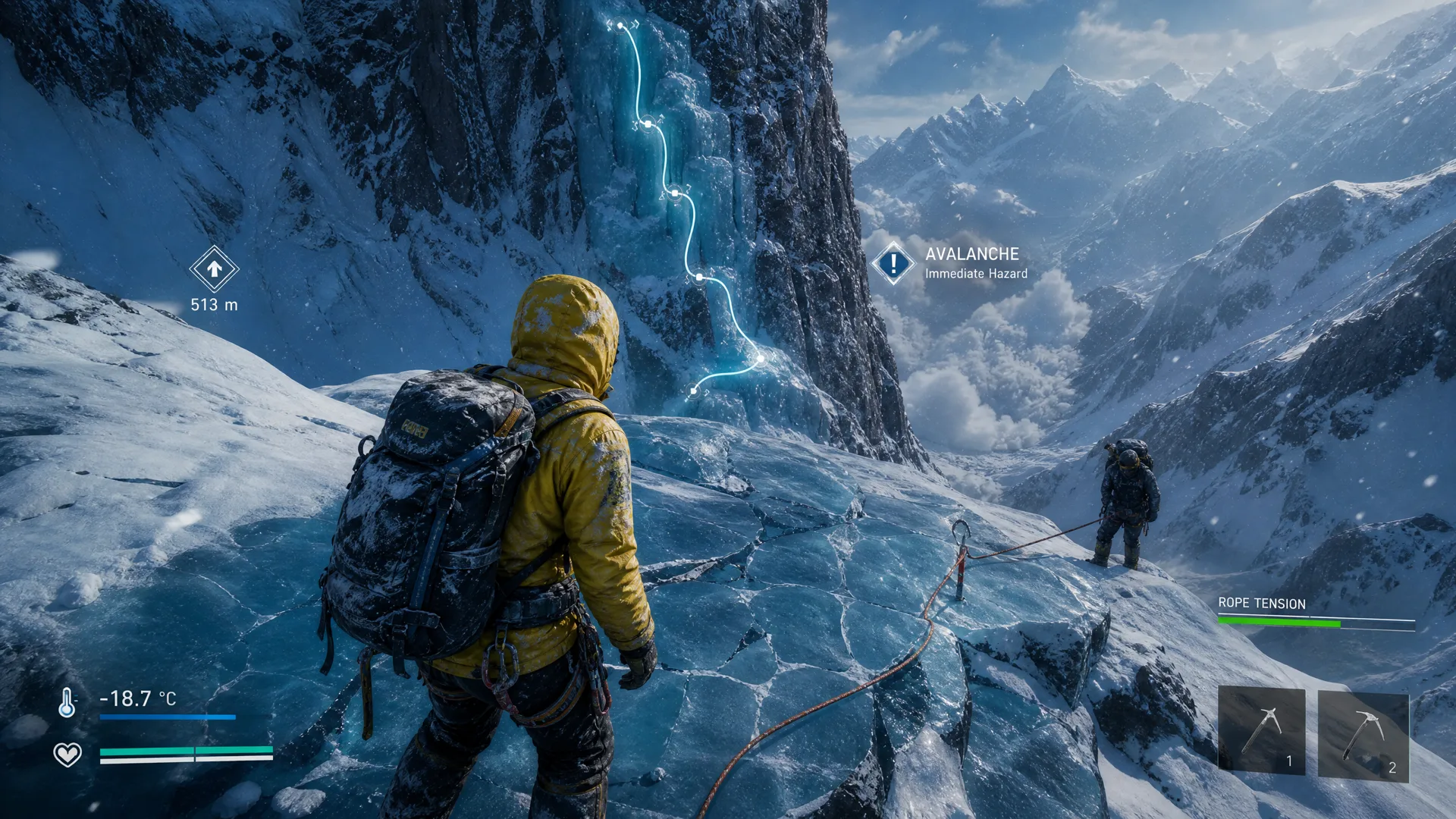
Glacier Wake opens its preview with the sort of scene that explains the whole pitch in a minute. Two rescuers edge across a fractured shelf above a blue-black drop, clipped to the same rope, carrying a stretcher frame they can barely afford to keep. It is a third-person co-op survival game from fictional Christchurch studio Aoraki Interactive, yet it does not chase cinematic swagger. Instead it chases weight: the weight of gear, the weight of weather, and most importantly the weight of another person depending on you.
That premise gives the game unusual clarity. This is not a broad open-world survival sandbox with a mountain skin draped over familiar systems. The preview is tightly focused on a rescue push through collapsing ice shelves, and every mechanic feeds that scenario. Rope tension decides movement, body heat punishes hesitation, route anchoring turns progress into labour, injury stabilisation reshapes priorities, shared supplies force argument and compromise, and weather windows dictate when bravery becomes stupidity. It is stern, but in the best way: every rule feels as if it belongs to this exact climb.
The Rope Is the Real Protagonist
The rope tension system is the cleverest part of the build because it turns cooperation into a physical problem instead of a spoken abstraction. Slack is safety until it becomes danger. Leave too much and a stumble can become a savage pendulum swing that drags both climbers off line; keep it too tight and the trailing player loses room to read terrain, step around cracks, or gather dropped kit. In practice, that produces constant micro-decisions: pause, shorten, feed line, brace, move together, stop again.
Route anchoring deepens that tension rather than duplicating it. The lead player places screws and pitons into surfaces that are not equally trustworthy, then clips the rope through in an order that determines how secure the next traverse will feel. Because the shelves are unstable, a route is never just about forward motion. It is about building a chain of believable safeties through suspect ground. That makes the preview’s traversal unusually absorbing. Even a short crossing can feel like a negotiated victory.
Cold, Exhaustion and the Politics of Shared Supplies
Body heat works as the game’s quiet tyrant. The metre drops faster in exposed wind funnels, after a dunking in snowmelt, or when an injured partner forces long stationary triage. Unlike many survival systems that nag from the edge of the screen, this one shapes tempo. A clear path may still be the wrong choice if it leaves you too cold to finish the next ascent. Warmth is restored through shelter, hot packs and stoves, but every solution costs time, fuel or carrying capacity.
That is where shared supplies become more than inventory Tetris. In the preview, no pair can carry everything comfortably, so loadouts become role decisions. One rescuer may take the bulk stove and splint kit while the other carries extra anchors, rope bags and emergency rations. The arrangement matters because the game loves separating need from access. If the medic falls into a lower pocket or the stove carrier is pinned by icefall, the situation changes immediately. Trust is not thematic garnish here; it is literally stored in each other’s packs.
Injury Stabilisation Gives Failure Consequences
When things go wrong, Glacier Wake avoids the familiar habit of reducing disaster to a lost health bar. A torn calf limits push-offs on steep sections, a shoulder injury slows anchor placement, and shock accelerates heat loss even after the initial fall is over. Injury stabilisation is therefore not a pause between action beats but a fresh layer of problem-solving. The healthy player has to secure ground, unpack the correct treatment, and spend precious weather time getting the other climber functional again.
The preview’s medical interactions are brief enough to avoid becoming chores, yet specific enough to create pressure. A splint, bandage or improvised wrap buys capability rather than full recovery, and that distinction matters. You are rarely restoring the team to its original state. You are deciding what kind of compromised ascent remains possible. The system also gives rescue fiction a satisfying mechanical spine, because saving a partner is not a cutscene reward. It is labour under worsening conditions.
- Assessment identifies the injury and the item needed.
- Stabilisation halts rapid deterioration and restores limited movement.
- Replanning adapts the route to the injured player’s reduced capacity.
Weather Windows Create the Preview’s Best Pacing
Many games use storms as spectacle; Glacier Wake uses them as editing. Progress comes in bursts during narrow weather windows, then contracts into defensive play when visibility collapses. The result is excellent pacing. You spend one stretch moving decisively across exposed shelves while sunlight hardens shadows and makes the route legible, then the next ten minutes become a panicked search for anchor points and snow walls before the wind strips all confidence from the climb.
That rhythm stops the preview from becoming monotonous, and it also supports the fiction of a rescue mission. The best moments are not necessarily the loudest ones. They are the anxious transitions when you both know the window is closing and have to decide whether there is time for one more traverse. Because the game’s hazards are systemic rather than scripted jump scares, those decisions feel earned. The mountain does not feel random; it feels indifferent, which is far more effective.
Level Design Understands Vertical Risk
The preview area is not vast, but it is layered with smart vertical design. Collapsing shelves create alternate lines, dead ends and emergency descents without ever becoming maze-like. Blue, load-bearing ice contrasts subtly with chalkier, brittle surfaces, and overhangs often promise safety while concealing awkward anchor angles or poor exits. You are always reading the space not just for the shortest route, but for where two tied bodies can move without turning one misstep into a shared fall.
Performance, Accessibility and a Measured Verdict
For a preview built around timing-sensitive traversal, technical steadiness matters as much as texture detail, and this build performs well. Frame-rate held consistent during whiteouts and heavy ice breakup in my session, with only brief hitching when large shelf sections recalculated and fractured. Accessibility support is encouraging too: subtitle scaling, high-contrast route cues, hold-to-toggle alternatives for strenuous inputs, and separate assists for rope readability and weather audio warnings. None of that trivialises the challenge, but it does widen the doorway into it.
The larger question is whether the final game can sustain this intensity without exhausting players or repeating the same rescue logic too often. On preview evidence, that is a fair concern, because its systems are intentionally demanding and emotionally cold. Even so, the fundamentals are unusually strong. Glacier Wake understands that co-op is most powerful when another player changes how the world works, not merely who stands beside you in it. If Aoraki Interactive can carry this discipline across a full campaign, this may become one of the sharpest alpine survival games in years.