
Welcome to the Dry Dock
There is a distinct, rhythmic satisfaction found in the clanking machinery and bustling wharves of Harbour Forge. Developed by the fictional Wellington-based studio Ironwood Interactive, this isometric shipyard-management simulation drops players straight into the deep end of a New Zealand dry dock. The premise is straightforward but layered with immense complexity: you are tasked with turning a disorganised stretch of coastline into a premier maritime manufacturing hub. It is a true test of spatial reasoning, financial acumen, and the ability to remain calm when a multi-tonne gantry crane stalls during a critical lift.
From the moment you break ground on your first modest slipway, the game makes its expectations clear. You must balance the grand vision of constructing ocean-going leviathans with the gritty reality of paying your workforce and keeping the lights on. The tutorial gracefully introduces the basics of laying down keels and erecting scaffolding, but it quickly steps aside, leaving you to grapple with the multifaceted systems that define the core experience. It is a demanding simulation that rewards meticulous planning and punishes haphazard expansion with swift financial ruin.
Modular Assembly and the Art of the Crane
At the heart of your operation lies the modular vessel assembly system, a brilliantly conceived mechanic that forms the backbone of the gameplay loop. Ships are constructed from prefabricated blocks that must be carefully manoeuvred into position. This modular approach demands a keen understanding of spatial logistics. You must allocate sufficient yard space for assembling these colossal components before they are ever brought near the dry dock, turning your facility into a complex puzzle of moving parts and shifting priorities.
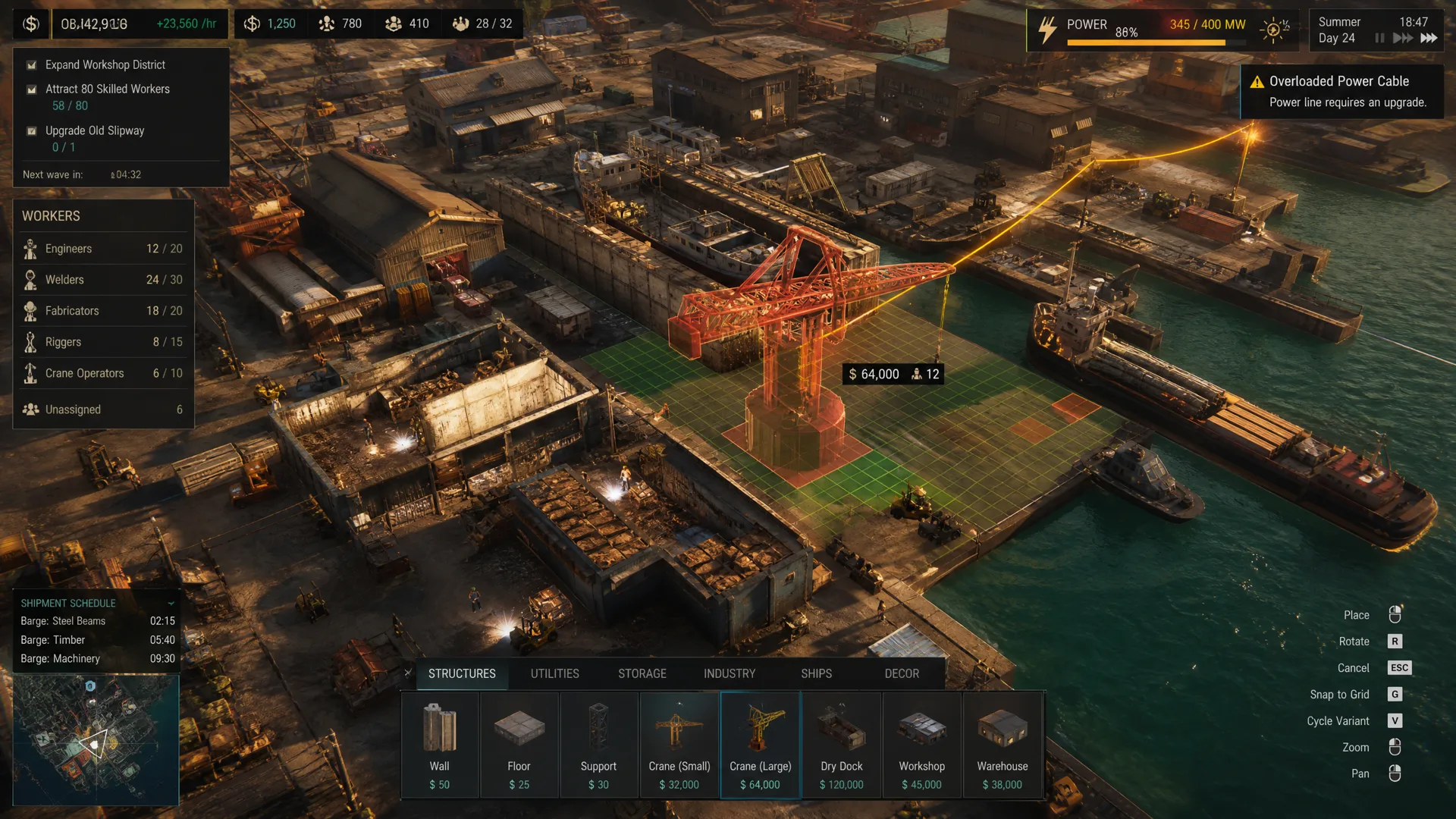
The true star of this assembly process, however, is the crane scheduling system. In Harbour Forge, your heavy-lifting equipment is the lifeblood of the yard, and managing it effectively is paramount. Gantry cranes, crawler cranes, and tower cranes each possess unique load capacities, reach limitations, and operational speeds. Players must meticulously schedule lifts to ensure that the right crane is available for the right module at precisely the right time. A bottleneck in crane availability can grind the entire assembly line to a halt, costing precious time and money.
Managing the Workforce and Labour Skills
No shipyard can function without a dedicated and skilled workforce, and Harbour Forge places significant emphasis on human resource management. Your employees are categorised into specialised trades, including welders, electricians, riggers, and foremen. Each worker possesses individual skill levels that dictate their efficiency and the quality of their output. Hiring a cheap, inexperienced crew might save money in the short term, but their sluggish pace and propensity for errors will inevitably lead to costly delays down the line.
To cultivate a truly efficient yard, players must invest in their staff. This involves setting up training programmes, managing shift schedules to prevent fatigue, and ensuring that experienced foremen are deployed to oversee complex tasks. The game introduces a nuanced morale system, where long hours and poor working conditions can lead to strikes or a mass exodus of your most talented personnel. Balancing the relentless drive for productivity with the well-being of your labour force is a constant, delicate juggling act.
Supply Chains and Delivery Logistics
The lifeblood of any manufacturing endeavour is a steady supply of raw materials, and the delivery logistics in Harbour Forge are unforgiving. Steel plating, engine components, miles of wiring, and specialised navigational equipment must all be procured from external suppliers. The catch is that your yard has limited storage capacity, and the access roads can only handle a certain volume of traffic. Ordering everything at once will result in a chaotic traffic jam of delivery trucks, blocking essential pathways and delaying critical shipments.
Players must employ just-in-time delivery strategies, carefully synchronising the arrival of materials with the construction schedule. This requires a deep understanding of lead times and supplier reliability. A delayed shipment of marine-grade steel can leave your entire welding crew idle, burning through cash while progress stalls. Conversely, over-ordering ties up valuable capital in unused inventory and clutters the yard, making it difficult for cranes and heavy machinery to manoeuvre.
Quality Control and Structural Rigour
In the high-stakes world of maritime engineering, mistakes are not merely inconvenient; they are potentially catastrophic. Harbour Forge integrates a rigorous quality control system that constantly scrutinises your work. Every weld, every electrical connection, and every structural alignment is subject to inspection. If your workforce is rushed or under-skilled, the likelihood of defects increases exponentially. These flaws must be identified and rectified before the vessel can be certified for launch, often requiring expensive and time-consuming rework.
To mitigate these risks, players must establish a robust quality assurance protocol. This involves hiring specialised inspectors and allocating sufficient time in the schedule for thorough checks. It is a constant battle against the temptation to cut corners to meet a looming deadline. The game brilliantly simulates the tension between speed and precision, forcing players to make difficult decisions about when to push their crew and when to prioritise structural integrity.
Deadlines, Cash Flow, and Economic Pressure
Underpinning the mechanical and logistical challenges of Harbour Forge is a ruthless economic engine. The shipyard operates on a knife-edge of cash flow, where the massive upfront costs of materials and labour must be balanced against the milestone payments received from clients. Contracts are bound by strict deadlines, and failure to deliver on time incurs crippling late fees. The pressure to maintain a positive bank balance is relentless, driving every strategic decision and operational compromise.
Effective financial management requires more than just balancing the books; it demands a strategic approach to contract selection. Taking on a massive, complex cruise liner might promise a lucrative payout, but if your yard lacks the necessary infrastructure or cash reserves to float the project through its early stages, it can quickly lead to bankruptcy. Players must carefully assess their capabilities and build their reputation through smaller, manageable projects before attempting to tackle the industry's most demanding commissions.
Presentation, Performance, and Isometric Design
Visually, Harbour Forge is a triumph of detailed, utilitarian design. The isometric perspective is perfectly suited to the genre, offering a clear, readable overview of the complex systems at play. The art direction leans heavily into the industrial aesthetic, with rusted gantries, sprawling concrete dry docks, and the vibrant, sparks-flying chaos of active welding bays. The lighting engine deserves special mention, particularly during the night shifts, where the harsh glare of floodlights cuts through the coastal fog, creating a deeply atmospheric working environment.
- Detailed isometric graphics that beautifully capture the industrial scale of shipbuilding.
- A robust and stable engine capable of handling complex simulations without stuttering.
- Excellent ambient sound design that immerses the player in the bustling shipyard environment.
Conclusion: A Triumph of Industrial Management
Harbour Forge is an uncompromising, deeply rewarding simulation that captures the monumental scale and intricate complexities of heavy maritime engineering. It is a game that demands your full attention, punishing carelessness while immensely rewarding strategic foresight and logistical mastery.
The fictional New Zealand setting provides a unique and grounded backdrop, while the commitment to authentic industrial processes elevates the game above standard management fare. The constant pressure of deadlines and cash flow ensures that the stakes remain high throughout, making every successful launch feel like a hard-won victory. While the steep learning curve and dense interface may deter some, those willing to invest the time will find one of the most compelling and robust management simulations in recent memory.